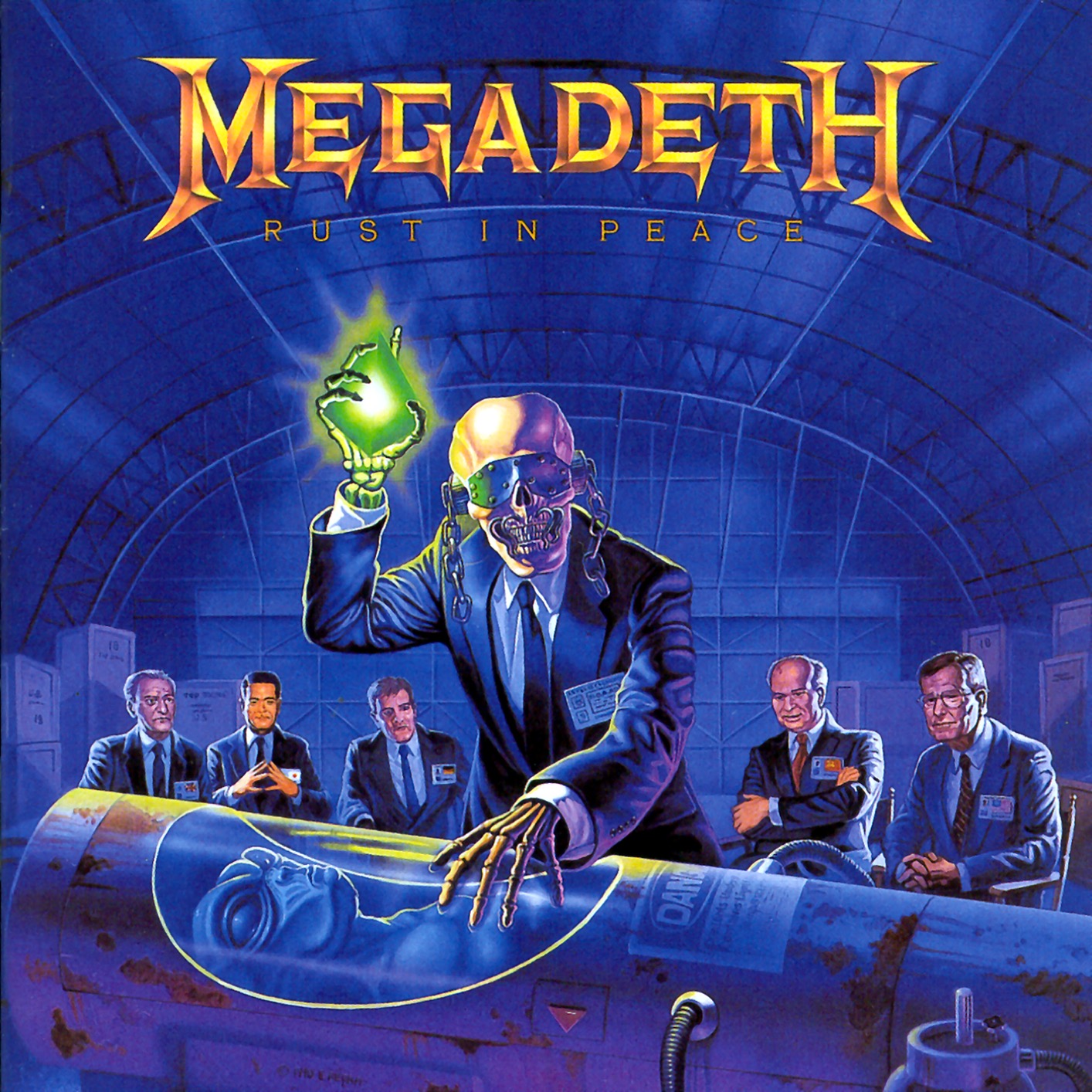
HEAVY MUSIC HISTORY: Rust In Peace – Megadeth
As the 1980s drew to a close, the wheels were coming off MEGADETH. Having let go of latest guitarist Jeff Young, the outfit was down to a three piece – founders Dave Mustaine (guitars, vocals) and David Ellefson (bass), and drummer Chuck Behler, each one festering in their own drug-induced chaos. Within the disarray, the first pieces of a new record started to coalesce.
“Dave and I started writing songs to demo in November 1988,” Ellefson recounts in Rust In Peace: The Inside Story of the Megadeth Masterpiece. It wasn’t long before early versions of three songs were demoed with Behler in tow; Holy Wars, Polaris and Child Saints (later retooled as Tornado Of Souls). It was a false start however. The Daves were in and out of rehab, leaving Behler to drift on the periphery before being unceremoniously replaced with his drum tech, Nick Menza, in 1989.
Menza bought a fresh energy to the band, not in the least as vices of beer and pot were more pedestrian than the coke, crack and heroin of the MEGADETH founders. Still officially a trio, another set of demoes were recorded, this time drafting in alumnus Chris Poland to provide some additional leads. Mustaine was clear that this was not going to be a moment of reconciliation, however. “There was no way I was ever going to ask Chris Poland to rejoin MEGADETH.”
By January 1990, MEGADETH were committed to recording a new album – second guitarist or not. By this point, the band had mooted a number of personnel; Jeff Waters (too busy with ANNIHILATOR), Dimebag Darrell (too tied to brother Vinnie), Jeff Loomis (too young) and even Slash (too nonsensical). It wasn’t until wunderkind Marty Friedman came in to audition that the last piece of the puzzle fell in place. Watching him take on MEGADETH’s leads, Mustaine recalled, “The world stopped. I knew I’d found my new guitar player.”
With that, studio time was booked for March. It’s under dispute how much material MEGADETH had ready at this point, though. In his autobiography, Mustaine states they had the majority written and little pre-production was needed. Friedman contradicts this in his own book, however, citing much of the work coming together during group rehearsals. “Even if Dave was the ringleader and arranger, he was arranging many parts that the rest of us came up with together.” While the album would be mostly credited to Mustaine in the end, Friedman wasn’t about to jeopardise his shot at the big time with songwriting politics just yet.
However, the reality of making an album with two recovering addicts was something Friedman wasn’t quite prepared for either. “I started attending these band meetings where they had drug counsellors from Alcoholics Anonymous and that was a whole new world for me,” he recounts in The Inside Story. The band itself hung in the balance of the founders’ sobriety and, while Ellefson would get off heroin by February, Mustaine started to fall apart at the start of recording.
“I kept watching Marty play… and I crumbled,” Mustaine candidly shares in his autobiography. The realisation that Friedman may have bested Dave as a guitarist was too much to handle. “I turned once again to the warm embrace of heroin and cocaine.”
The timing wasn’t ideal. The band got as far as recording scratch tracks at Rumbo Studios before Mustaine was sent away to rehab. Producer Mike Clink was kept in the dark, with the band worried Mustaine’s off-the-wagon status would spook him. Instead, Ellefson assumed the role of musical director and got to work with Clink and the band to make sense of the increasingly complex material.
By Friedman and Ellefson’s accounts, Mustaine was only there for around half of the album’s recording. And while the rhythm section of Ellefson and Menza remained fighting fit, Marty was hiding the fact he had sustained significant nerve damage in his right arm. His temporary solution was to play economically – no warm ups and doing as few takes as possible. Somehow, despite Friedman conspicuously icing his arm the rest of the time, the rest of the group were none the wiser.
Around a month in to the sessions, a clean Mustaine resurfaced and miraculously with his guitar chops completely intact. Vocally though, Ellefson had reservations as Dave stepped up to the microphone. There was a thinness and almost tentative quality to Mustaine’s trademark snarl as he cut Holy Wars, but the rawness was compelling. “It captured the entire essence of where we were at that exact moment, this masterpiece that we had created in the darkness of heroin and were now recording freshly sober,” Ellefson recounts.
That sober clarity permeated Rust In Peace. With Mustaine back, the rest of the album fell in to place quickly, sounding clean, tight and mechanical. Its material boasted erudite song arrangements, with frequent tonal and tempo shifts that would have fallen apart in the hands of lesser musicians. By comparison, its predecessor So Far, So Good… So What! sounded like a thrashy haze. Clink’s meticulous work as producer had helped ensure a structured foundation, even if he did get called away by Axl Rose around four-fifths in to the sessions. With the rest of the recording handled by engineer Micajah Ryan, it was Blizzard Of Ozz producer Max Norman who gave Rust its final sheen – a punchy, urgent mix that shone a light on all four members.
Crucially, the material was still as caustic as you’d expect from a MEGADETH record. Encompassing everything from nuclear fallout to tumultuous relationships, Mustaine’s words and imagery were the most articulate they had ever been on Rust In Peace. While often touted as the frontman’s magnum opus, it was clearly an album that could only form through the herculean effort of multiple people – sometimes, in spite of Mustaine. As he reflects, “Even as much as I want to take credit for my part in it, I know that it was a cast of players.”
The resulting record was a new lease of life for a band on the brink of self-destruction, with MEGADETH becoming road-worthy all over again.
Rust In Peace was originally released on September 24th, 1990 via Capitol Records.
Like MEGADETH on Facebook.