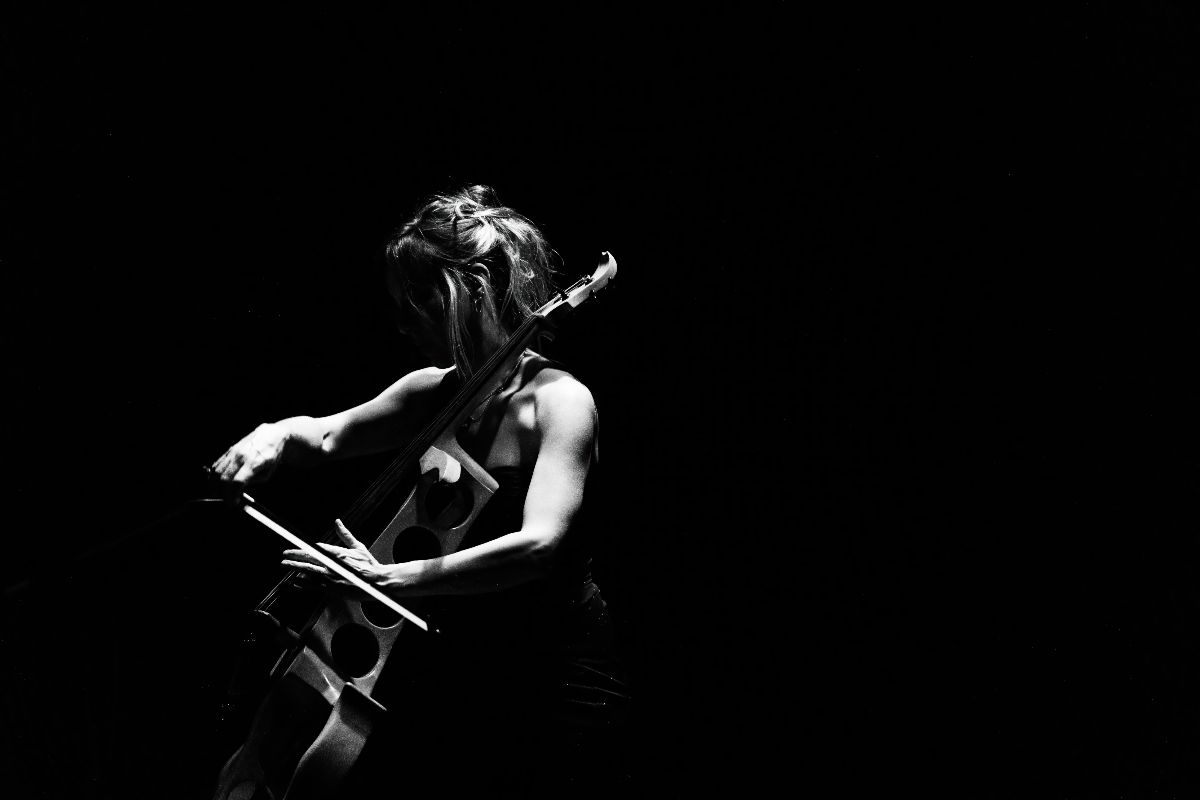
Jo Quail: Orchestrated Heaviness
Heavy bands in the experimental rock and metal space featuring a combination of distorted guitars, bass, and drums are ten a penny. Plenty of acts will throw in some curveball instruments alongside variants of that typical base. But there aren’t too many solo cello acts that can hold their weight on a post-metal concert bill. Armed with a futuristic-looking electric cello, loop station and effects pedals, JO QUAIL has become a mainstay of the heavier genre scene, appearing on festival line-ups and tours with the likes of GOD IS AN ASTRONAUT, CULT OF LUNA, BORIS and AMENRA, to name a few.
Those combinations may seem unusual, yet the receptions are universally warm. “I never questioned it, because I know the power of juxtaposition in music,” says Jo. Over a decade of touring and collaborations has seen her navigate goth, post-rock and more experimental scenes with consistent and growing support. “I’ve always found the rock and metal audience to be very broad-minded. It works, I think, because there is the same approach to the delivery of the music.”
That is certainly evident when listening to JO QUAIL’s music, whether in the form of acoustic cello akin to contemporary classical music, multi-layered electric cello performances, or in the symphonies of her more recent work. Those include the Invocation and Supplication EPs from 2023, recorded with Maria Franz (HEILUNG) and LEF, as well as the Roadburn-commissioned piece The Cartographer from 2022, which sought to explore the intersection of classical and contemporary heavy music. That word “heavy” feels like the most fitting descriptor, though Jo is more circumspect: “Heavy is only a measure of something. There are moments which are not heavy!” She summarises her sound more fittingly: “Broad, cinematic and intense.”
Her seventh album, Notan, was released in September, stripping back the recent collaborations and symphonies in favour of haunting solo performance. Recorded as live takes, it’s a record of raw energy and deftness, whether in the acoustic cello runs of A Leaf And Then A Key, or in the meticulous layered sound design of Butterfly Dance and its scraping overdrives. Yet these songs were not initially intended for Notan – seeming better suited for full orchestration. “[I had] these series of improvisations that were chaotic, and crazy, and wild, and un-boundaried,” says Jo. “I couldn’t unpack them. I really liked them how they were. And I knew that it would take some kind of Herculean effort to create them on cello. So I thought, well, I’ll just do it for orchestra.”
That remains a work in progress – a future album, Ianus, a symphony set for recording with the Brabant Sinfonia Orchestra in Tilburg, which shall share four pieces with Notan. “That was the first version of these pieces, Ianus. Notan is a distillation of those pieces.” Notan emerged later – a companion piece, albeit one that naturally presented lower logistical barriers to recording and producing. “They’re very much a pair. They will complement one another, I think, when Ianus is ready.”
The growing body of work on the orchestral side poses a provocative question. Would writing for and performing with orchestras always be the preference if money and logistics were no object? Certainly, the economics are challenging, and events such as her planned orchestral performance in Holland in November require a lot of effort to put together. “I write for very big orchestras. [For the Holland show] in November, I have got 100 people, and I need 100 people. I need this volume, this impact of sound, which you can’t really get from a chamber ensemble.” The ideal would be a mix of small, intimate solo shows alongside more of these vast orchestral performances. Though in her eyes, the creative process has plenty of overlap. “Orchestration, sound design, composition, they’re all the same. One talks about notes like F# and A, and the other talks about 120Hz or 3kHz… It’s the same thing.”
Alongside her solo albums, Jo has a prolific body of work in the form of guest spots on albums across the heavier music spectrum. Her credits read as a who’s who of post-rock and metal: MONO, CASPIAN, ENSLAVED, WREN, SAOR, the list goes on. “I feel very privileged to say that people will ask me to play because they want my particular approach to cello playing on their music, rather than a cello in general.” What are some of the standouts for her? A few examples come to mind – the SUPERVØID project with Eraldo Bernocchi, for its dynamic, collaborative creative process. The EMMA RUTH RUNDLE album Engine of Hell is also a highlight: “That was like holding a very precious Fabergé egg… it had to be very carefully thought about because the whole album is so raw. It cannot be diluted in any way at all.” And of course, her work on Embers with GOD IS AN ASTRONAUT, with whom Jo has toured extensively over the past couple of years.
Notan nods to the past as well with a re-recording of Rex, one of the earliest JO QUAIL songs. It provides a good moment for reflection on a busy career – what has been the most significant change to creating music over that span of time? “Probably the advancement of technology, and the advancement of my confidence as a performer,” says Jo. “I can get much bigger sounds now than I used to because I’ve got a lot more compressors at my disposal! And I’m much more confident.” A smile. “Or perhaps I’m less bothered by inaccuracies than I used to be.”
Notan is out now via AdderStone Records. View this interview, alongside dozens of other killer bands, in glorious print magazine fashion in DS124 here:
Like JO QUAIL on Facebook.