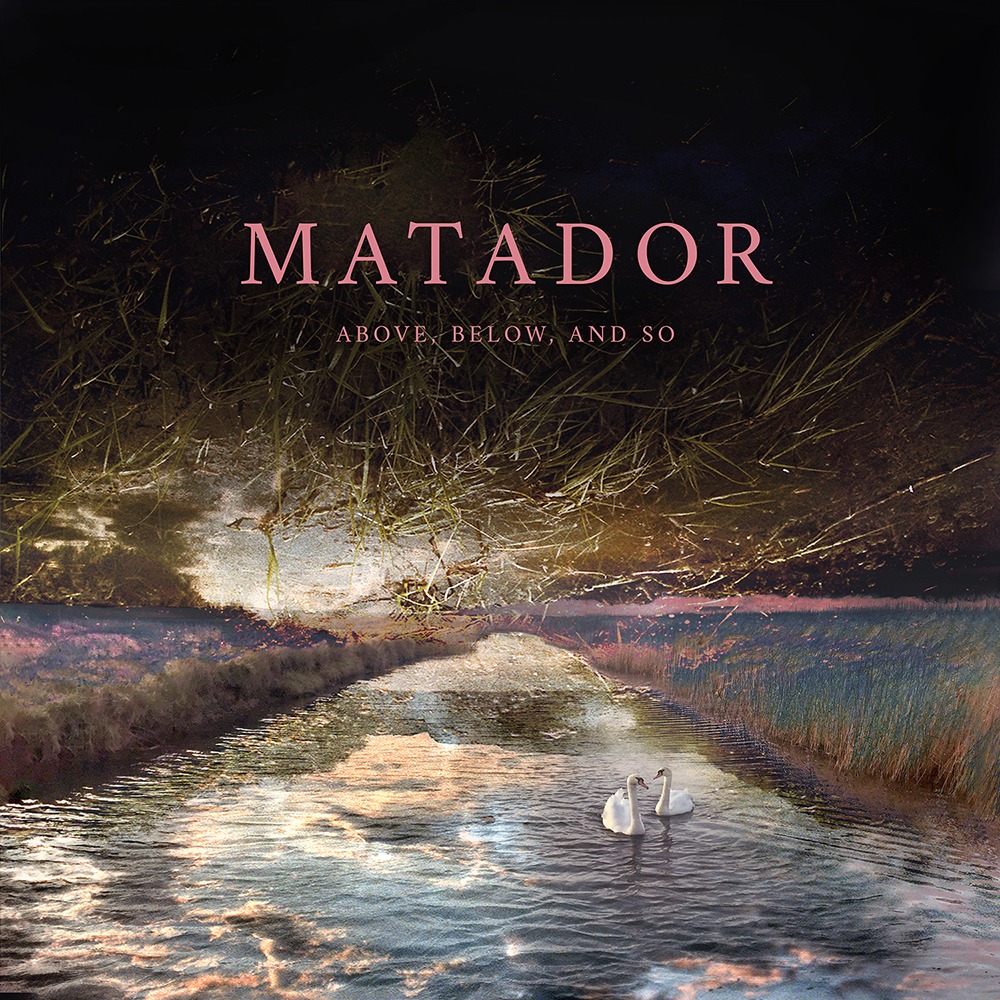
ALBUM REVIEW: Above, Below And So – Matador
Post-metal and baking go hand-in-hand: they evoke intense emotional responses, they experiment with ingredients to create new flavours, and they’re both sciences masquerading as art forms. Only Brighton-based trio MATADOR‘s third album, Above, Below And So, challenges this theory.
Their longest album by 10 minutes, Above, Below And So is MATADOR‘s most ambitious statement yet. Despite the trio of James Kirk, Mark Ainsworth, and Scott Stronach pushing their post-metal towards beginner level accessibility, the result itself is frustrating – an undercooked cake where the ingredients have been measured correctly and the recipe followed with care, but the final product needed a few more minutes in the oven to fully rise.
Opening track The House Always Wins is at war with itself, establishing both the album’s strengths and shortcomings. Feedback-drenched riffs soak eardrums like waves threatening to ruin a day at the beach, Kirk‘s softly-spoken delivery casting a calm-before-storm atmosphere. There’s ambition here, particularly when MATADOR shift into mammoth melodic sections with electrifying riffs and arena-sized grooves that wouldn’t feel out of place on a BIFFY CLYRO or ALTER BRIDGE record. Yet Kirk‘s half-baked deliveries and an unnecessary false ending undermines everything. After nearly seven minutes building atmosphere, returning moments later with near-muted guitar lines that fade back out feels unearned, like a ‘good’ sketch of a potentially ‘great’ song.
Glitter Skin continues this pattern. Its cinematic basslines drowning in reverb bring a darkly, twisted groove to the table, whilst harmonious riffs roll calmly above the mix. Kirk‘s layered guitar parts simmer before boiling, whilst his vocals transition between near-whispered cleans and sabre-toothed howls. The TOOL comparisons are unavoidable: think 10,000 Days-era dynamics where music rises and falls like a classical composition, with guitar and bass parts coalescing like a complex Rubik’s cube working itself out in real-time. Yet once again, the ingredients need a little more time to bake through, to truly bring out a feeling within you.
Midway through, MATADOR show their hand in what they’re truly capable of. The Flood threatens to unleash groove-laden, funk heavy riffs you’d expect CORROSION OF CONFORMITY and CLUTCH to throw your way, before Kirk folds in textural wave-like riffs. Stronach‘s fast-and-furious drumming leaves way for Ainsworth‘s bass to sludge up the mix, whilst Kirk’s guitar moves between rich, honey-dripping melodies and chugging dystopian riffs. Then the whole song drifts off into its own horizon-like interlude: free-jazz drums, basslines floating in and out of audible consciousness, and guitar parts soundtracking the rise and fall of a flower from seed to rot.
Brief interlude O Suna similarly excels. At just two-and-a-half minutes, its opening riff shimmers in melodious glow like glitter reflecting in sunlight, radiant yet sinister as a foreboding, reverb-drenched bassline slowly unburies itself and takes over the mix, replacing calm with anxious paranoia that won’t subside. This, like The Flood, succeeds in evoking genuine emotion, sending listeners to spaces they perhaps didn’t want to go.
Sadly, the album’s back half returns to familiar frustrations. Ten-minute centrepiece A Virus opens atmospherically and cinematically, its singular dissonant riff and clattering cymbals leaving listeners uncertain and uncomfortable. Kirk‘s lo-fi scream buried halfway in the mix explores what feels like disease’s cruel toll on our physical and mental attributes: “fireworks in my mind, a death that’s so unkind I’ll bleed you a river.” The lyrics are excellent, the improv-like jazz drumming ambitious, but the music doesn’t match the emotional gravity. Sections linger too long, a lulling instrumental stretches like a baker rolling out dough for far too long, repeating earlier sounds without building on them. Like The House Always Wins, it fades to black before arising again like an uninspired phoenix, delivering a cinematic drone that doesn’t quite belong.
MATADOR’s ambition deserves credit. Like GOJIRA‘s shift from technical death metal toward commercially accessible prog-metal on Magma and Fortitude, Above, Below And So clearly aims to welcome new listeners into post-metal’s challenging terrain. Mark Ainsworth‘s bass work throughout, constantly throbbing, pulsating, creating headache-like migraines of sound, provides a formidable backbone. But in prioritising accessibility, they’ve occasionally lost sight of the genre’s cornerstone. When it works, it proves the band is capable of greatness. Too often, though, this feels like an album that needed more patience in the rehearsal room to transform good ideas into great ones.
Rating: 6/10
Above, Below And So is set for release on February 27th via Church Road Records.
Like MATADOR on Facebook.