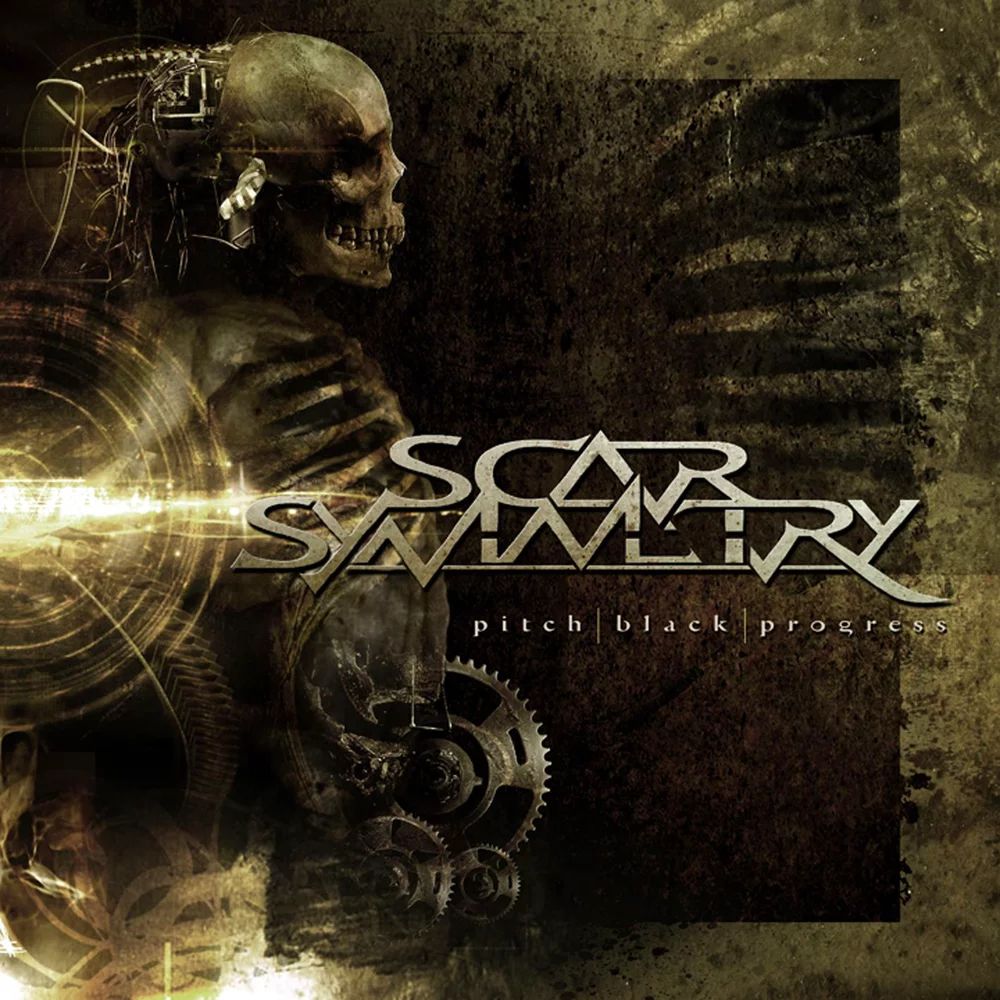
HEAVY MUSIC HISTORY: Pitch Black Progress – Scar Symmetry
Christian Älvestam could lay claim to one of the most big-headed boasts in the history of metal. When he was fired from his job singing for SCAR SYMMETRY in September of 2008, the Swedes had to hire two new vocalists just to fill the void. His successors – Roberth Karlsson and Lars Palmqvist – were both impressive talents, but they still struggled to match his abilities even with the numbers advantage. It was years before the band’s established fanbase were ready to accept them. If you listen to Christian’s penultimate record with the band, you’ll understand why.
His performance on Pitch Black Progress is impeccable. Over the course of the eleven tracks and fifty-minute runtime, he alternates between subterranean death growls and pristine clean singing with astonishing skill. He’s a charismatic and engaging focal point, with an enviable level of control. But while he threatens to steal the show, SCAR SYMMETRY were never a one-man band. Christian Älvestam is exceptional, but his bandmates were all remarkably talented too, and there’s a subsection of fans who’ve never quite got over that. It’s an excellent album, but it became something of an albatross around the band’s collective neck.
Released in April 2006 on Nuclear Blast, Pitch Black Progress was a landmark for SCAR SYMMETRY. It was greeted with positive reviews from the press, and moderate commercial success, then gradually grew in stature as word of mouth spread. SCAR SYMMETRY didn’t become heroes overnight, but as more and more people embraced their second album, it turned into a fan favourite. We’re now two decades since it first appeared on the shelves, and it’s come to be regarded as a masterpiece.
In hindsight, that seems inevitable, but at the time there was no guarantee. Christian’s strengths on the mic were undeniable, however his style was becoming old hat by 2006. The success of KILLSWITCH ENGAGE and the wider New Wave Of American Heavy Metal had led to an overwhelming number of likeminded bands coming out of the woodwork. The screamed verse into sung chorus approach that revolutionised popular metal was growing stale. SCAR SYMMETRY could all too easily have got lost in the mix, been dismissed as another bunch of idealistic trend-chasers, and vanished into obscurity, but they had one major advantage over the competition.
They weren’t metalcore. Sure, they might bear the hallmarks of the dominant metal subgenre of the era, but they stood apart. They began their careers surrounded by Scandinavian contemporaries like AT THE GATES, HYPOCRISY, and ONE MAN ARMY AND THE UNDEAD QUARTET, and their music was firmly rooted in European metal rather than American ‘core.
The guitar playing of band founder Per Nilsson is focused more on spiralling melodies and fast riffs, than big chuggy breakdowns, and there is an abundance of synths worked into the mix. You could mistake SCAR SYMMETRY for another derivative metalcore band on the first listen, but by the third they start to sound more like the precise meeting point between death and power metal. Nilsson, Älvestam, and indeed any member of SCAR SYMMETRY could join BLOODBATH or HAMMERFALL without anyone batting an eyelid.
For example, take The Illusionist. The album’s opening track and lead single is almost the entire SCAR SYMMETRY ethos condensed into four and a half minutes. It opens with a sweetly harmonious intro, rapidly escalates into a pounding death metal number, only to just-as-quickly turn into a massive singalong chorus before sixty seconds have passed. This song teaches you everything you need to know about Pitch Black Progress, and it’s just the start.
Slaves To The Subliminal is a flawlessly executed follow-up. It’s defined by the complex fretwork and while it might sound like a contradiction in terms, could even be described as “elaborately simple.” It sounds like a group of preposterously talented prog musicians got together and wrote a radio-friendly unit shifter, and it’s great. The following Mind Machine then gives Älvestam the lead role; the massive, grinding opening riff suggests it’ll be pure mosh fodder, but instead it evolves into one of the most sweetly anthemic tracks on the album. The death metal takes a backseat, and Christian gets to sing an instantly memorable chorus over music reminiscent of eighties power ballads.
Elsewhere, their proggy side comes to the fore with the mini epic The Kaleidoscopic God, Calculate The Apocalypse shows SOILWORK how to do melodeath, and the title track demonstrates just how heavy SCAR SYMMETRY can be when the keyboards are turned off. Plus, there’s Retaliator, a fiendishly straightforward pit-trigger that rapidly became a fan favourite. Ever wanted to know what happens when PhD students write a mosh anthem? We got the answer in 2006.
But this begs the question, why didn’t SCAR SYMMETRY become a household name when they had everything going for them? Well, their singer took up so much of the goodwill, that they lost a ton of momentum when he left. SCAR SYMMETRY had one more Älvestam-fronted record in them – 2008’s equally good Holographic Universe – but that was only out for about ten minutes before he left. Creative differences and the stress of touring drove a wedge between the band members, and despite rave reviews, their third album was overshadowed by his departure.
To make things worse, in the immediate aftermath, it became apparent that a sizeable chunk of their audience were fans of Christian Älvestam, rather than SCAR SYMMETRY as a whole. The hastily-recorded fourth album – 2009’s Dark Matter Dimensions – was actually pretty good, but not up to the standards of the predecessors. The critics were kind, but their fans weren’t. They accused Per Nilsson and the others of selling out, trying to appease the mainstream, and turned their backs. For some reason, there was also a brief fuss over a widely circulated image of the album art with Pinkie Pie from MY LITTLE PONY photoshopped into it.
SCAR SYMMETRY grit their teeth and kept going, with two singers instead of one, and to be fair, they continued making terrific metal. 2011’s The Unseen Empire is an oft-overlooked gem, but it took until 2014’s The Singularity (Phase 1 – Neohumanity) for the recovery to begin in earnest. They still haven’t managed to reach the unparalleled high point of Pitch Black Progress in terms of commercial success, but they remain a creative and enduring force in melodeath. Fatherhood and the demands of modern life, not to mention Nilsson’s five-year stint as a touring guitarist for MESHUGGAH (how’s that for an endorsement?) have perhaps ended the chance of them ascending to a higher level, but still, they’ve done well.
As for their former singer, he remains something of a cult figure. Christian went to work with a veritable catalogue of bands. Alongside some solo work, he’s been part of MISERATION, SVAVELVINTER, CYPHER SYSTEM, TORCHBEARER, and a whole host of other acts. However, he rarely, if ever tours, and you’d be hard pressed to find more than a handful of live shows for any of them listed online. Perhaps his best-known work post-SCAR SYMMETRY is with SOLUTION .45, a supergroup that had some serious momentum at one point but slowly ran out of motivation and disbanded.
While his time with SCAR SYMMETRY was relatively brief however, the impact was considerable. Pitch Black Progress is rightly recognised as a classic nowadays and has been noted as an influence on numerous bands that came after them. You can trace a path from SCAR SYMMETRY to acts like MUTINY WITHIN, and Josh Dummer’s one-man BURIED REALM project might as well be a love letter to them. Pitch Black Progress left an incredible impact, even if its creators didn’t benefit from it as much as they should have.
Pitch Black Progress was originally released on April 21st, 2006 via Nuclear Blast Records.
Like SCAR SYMMETRY on Facebook.