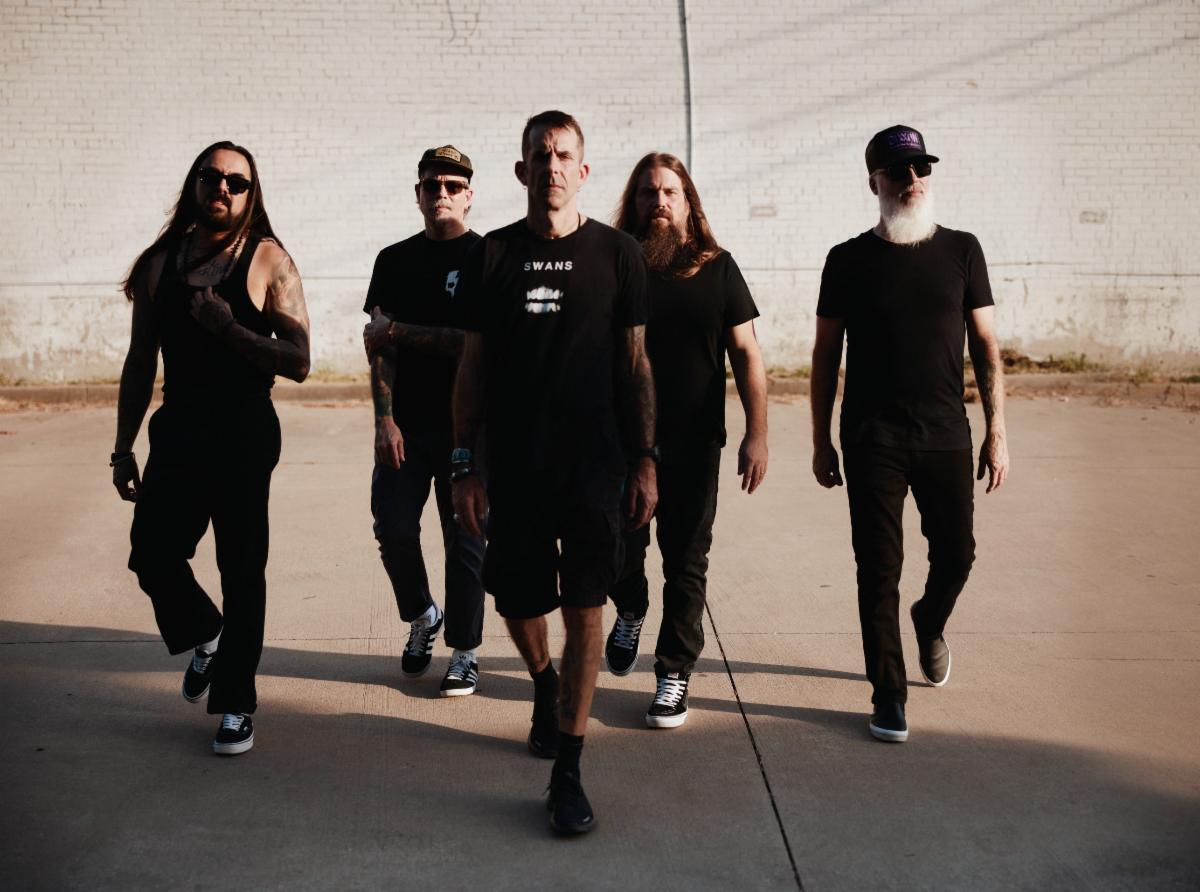
Lamb Of God: Running Into Oblivion
Ask Randy Blythe whether LAMB OF GOD’s headline set at Bloodstock 2026 might bring a special set celebrating the twentieth anniversary of Sacrament, and he doesn’t pull punches. “I hope not,” he says. “That’s my least favourite LAMB OF GOD record.”
It is the kind of answer that makes a press officer wince. It’s honest, unprompted, and entirely characteristic of a man who has never managed to say what he is supposed to say. He clarifies, gently but firmly. “I don’t hate the record, it’s just my least favourite one. It has a lot to do with my personal state of being during the recording of that record. I’ve been sober fifteen years now, and I was not sober during the recording of that record, and it was not good.” The dark days of that album are not ones he particularly wants to revisit.
What he would rather talk about is Into Oblivion, LAMB OF GOD’s tenth studio album and the record that may well represent their most vital work since 2015’s VII: Sturm und Drang. It is a comparison worth sitting with. Sturm und Drang arrived in the wake of Blythe‘s acquittal on a manslaughter charge in the Czech Republic, a record forged from the psychological extremity of facing imprisonment in a foreign country for a crime he did not commit. Blythe and guitarist Mark Morton have spoken previously about wanting a title that reflected the psychology of humans reacting under extreme conditions. Into Oblivion finds Blythe returning to that territory, except the extreme conditions are no longer his alone. They belong to all of us.
“The state of the world we’re in and my internal state are inseparable,” he says. “Things are not good, in case anyone hasn’t been paying attention.” The America Blythe documents on Into Oblivion is one in freefall; politically fractured, morally exhausted, and stumbling willingly towards collapse. The album’s title is not a warning or a question. It is a conclusion. “I think we are as a planet, as the human race, at a tipping point,” he says. “Things can go very badly, or people can pull their heads out of their arses and start seeing the humanity in each other.”
What makes Into Oblivion more than a political broadside is the degree to which Blythe implicates the ordinary alongside the powerful. The billionaire class grows whilst everyone else falls further behind, and none of it, he argues, happens without our permission. “This does not happen without us allowing it. We have become too easily disengaged and distracted and fatalistic about our lot in life.”
He is particularly alert to the disillusionment of younger generations. “Young people in particular are jaded a lot. I think they feel disempowered and I understand why. I don’t think it’s their fault, because they’re raised in this environment where the democratic safeguards are being dismantled.” But his patience for fatalism runs thin. “It’s time to re-engage and realise that we as a community matter. There’s more of us than there are billionaires, right? They don’t get to hold onto their fucking toys if we don’t let them.”
The record’s emotional core is something more personal. El Vacío – Spanish for the void – is the album’s outlier: melodic, melancholic, almost elegiac, built around a musical idea Morton developed from notes Blythe had written during the writing process. “The lyrics to that song I’m talking about publicly, because I want the meaning to be known,” he says. “If there were two people I wish were still alive to comment on this crazy world, one is Hunter S. Thompson. The other is my friend Dave Brockie, who sang for GWAR.” The two verses are dedicated to each – Thompson for his ferocious political intelligence, Brockie for his ability to make the darkest moments bearable. “No matter what was going on in the world, no matter how grim, he always had something insightful to say and always made me feel better.” It is a quiet act of grief tucked inside a record that otherwise rarely drops below a roar.
That roar carries a distinctly punk sensibility, most audible on Into Oblivion’s B-side. “I think there’s a more hardcore punk feel to the entire record in general,” Blythe says. “That’s my background. I don’t come from the metal scene and somehow wound up in a metal band.” The vocals were recorded at Total Access Recording in Redondo Beach, California, whose walls are lined with records that shaped him as a teenager. “I walk in and I see BLACK FLAG’s My War, I see a DESCENDANTS record, I see HÜSKER DÜ,” he says. “I’m like, oh, this is awesome.”
He recorded separately from the rest of his bandmates – Morton, bassist John Campbell, drummer Art Cruz, and guitarist Willie Adler – who tracked in Richmond for reasons that are entirely practical and very Blythe. “I can’t come home and see my girlfriend and be like, ‘Hi honey’ after I go to the studio. I’m not a normal person when I record, I’m normally in a horrible mood the whole time. I think I better remove myself so I’m not a jerk to the people around me.” His self-imposed isolation suits the material, adding another layer to his urgently venomous delivery.
Producer Josh Wilbur, behind the desk for every LAMB OF GOD album since 2009’s Wrath, was the final piece. Their relationship, Blythe admits, is not without friction. “At times it’s frustrating because I feel like, ‘dude, you’re pushing me into some place where I wouldn’t naturally go’, and at times he’s correct to do that, but then other times he’s incorrect.” The implication, that records like Omens suffered from that dynamic, is something any attentive listener can hear for themselves. This time was different. “He was pretty focused on getting the best performances out of me and letting me be me.”
At just under forty minutes, Into Oblivion is their shortest record since 2003’s As The Palaces Burn. “We have a saying in LAMB OF GOD: better is better,” Blythe explains. “It’s learning to let go of things that perhaps do not serve the greater whole. Is it better with it or without it? If it’s better without it, it’s got to go.” This all killer, no filler approach suits the material. This is not a record that wants to linger; it has a message to deliver.
Where does it sit in the catalogue? Blythe is characteristically resistant to the easy answer. “You’re supposed to say this is the best thing we’ve ever done,” he says, “but I don’t say what I’m supposed to say, because I’m a cantankerous old man, and haven’t since I was a kid. I will tell you I feel much better about this record than I did our last one.” Better than Omens, and better, arguably, than anything since Sturm und Drang, the record it most closely echoes in spirit if not in subject. Both were born from extremity: one man’s survival under impossible pressure, and now an entire civilisation facing the same test. In 2015, Blythe found his way through. In 2026, the verdict is less clear. Into Oblivion does not offer resolution. It offers honesty, fury, and the faint, stubborn conviction that there are still enough of us willing to fight back. For LAMB OF GOD, at this point in history, that may be the most punk rock statement of all.
Into Oblivion is out now via Century Media & Epic Records. View this interview, alongside dozens of other killer bands, in glorious print magazine fashion in DS128 here.
For more information on LAMB OF GOD like their official page on Facebook.